
Solar Panel Cleaning Robots for Commercial
No electricity | No rails | No operator
Recover Lost Solar Revenue - Automatically
Most cost-effective | Water-powered cleaning robot for commercial solar panels
No electricity | No rails | No operator
The Problem
Dirty Panels Drain Profits

Solar panel efficiency can drop by up to 60% due to dust and debris.
Manual cleaning is costly, dangerous, and outdated.
Current solutions don’t scale or automate.
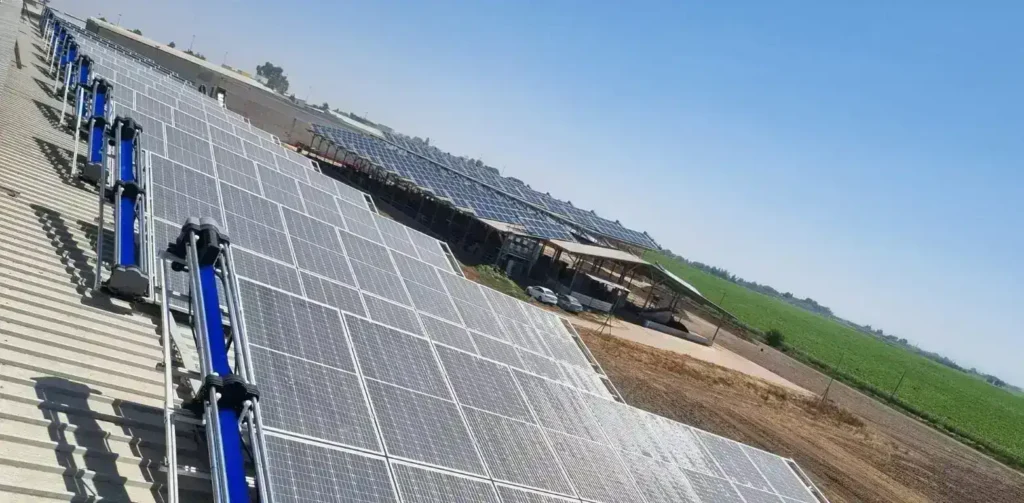

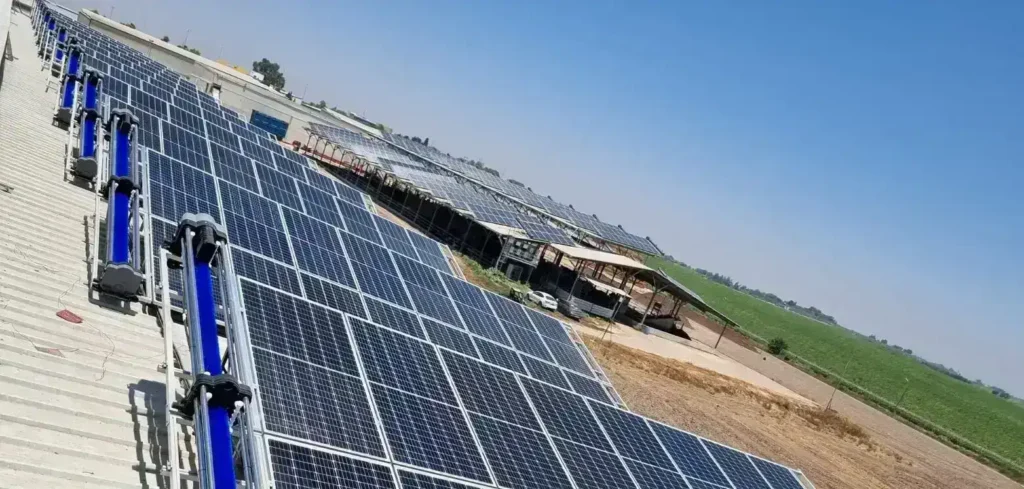
Engineered for the Real World. Powered by Water.
What Solaris Does Best
Precision Washing
99.5% dust removal in one pass
Ingenuity
Water-powered – no electricity required
Versatile
Works on rooftops, ground, floating, agrivoltaic
Autonomous
Fully autonomous with smart scheduling
Monetary Value
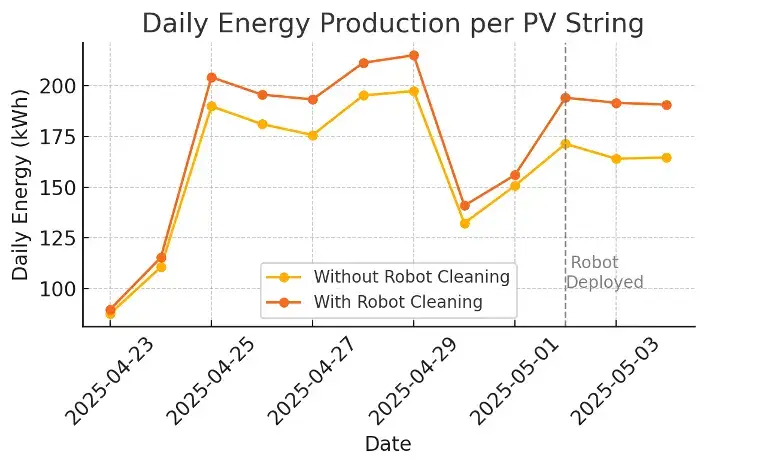
10–25% yield improvement
Our Solutions
Floating Solar Panel Cleaning (Beta)
Deploying solar arrays across water reservoirs, industrial ponds, and hydroelectric lakes represents a masterstroke of spatial efficiency, yet it introduces some of the harshest operational liabilities in the renewable sector. Floating photovoltaic (Floating PV) systems are continuously bombarded by rapid bird dropping accumulation, intensive ambient humidity grime, and aggressive organic
Utility-Scale Ground-Mounted Solar Cleaning Systems
Maintaining consistent peak energy generation across hundreds of acres of distributed energy assets requires a highly scalable and mechanically sound operational framework. Large-scale photovoltaic installations are continuously exposed to intense environmental challenges, from airborne dust storms and localized sand accumulation to aggressive agricultural or industrial soiling. Solaris Hydrobotics provides a
Agrivoltaic & Agro-Solar Systems Cleaning Solutions
In an era defined by diminishing land availability and intensifying water scarcity, the global energy and agricultural sectors are rapidly converging on dual-use land management. Solaris Hydrobotics’ innovative dual-use technological framework completely redefines agricultural profitability by harmonizing clean energy production with sustainable farming. Our proprietary engineering leverages existing farm infrastructure
Commercial Rooftop Solar Cleaning Systems
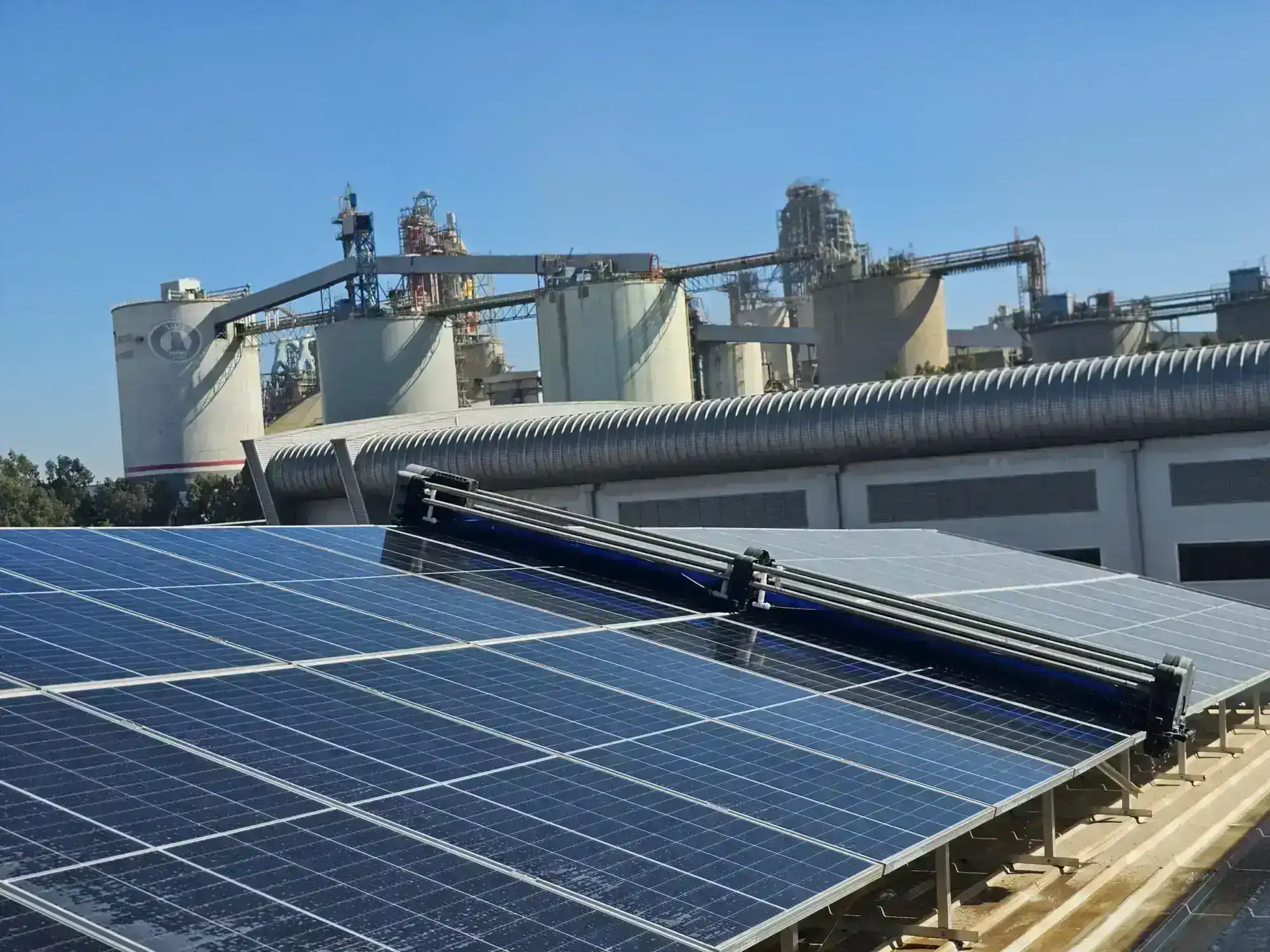
Maximizing energy efficiency on distributed solar assets requires an optimization strategy tailored to specific physical structures. For small-to-medium commercial, agricultural, and industrial rooftop PV arrays ranging from 14 to 50 kW, traditional maintenance paradigms break down entirely. High-scale utility cleaning machinery is heavily over-engineered and physically incompatible with constrained roof
About Solaris Hydrobotics
Solaris Hydrobotics develops and offers autonomous, water-powered robots designed for cleaning solar panels in agricultural fields, commercial rooftops, small solar farms, and floating PV systems. Our innovative, patent-pending technology uses water to power the robotic cleaners, rotate the brushes, and wash away dirt. With no need for electrical motors or expensive infrastructure, our autonomous robots provide a cost-effective, sustainable solution that makes regular panel cleaning both affordable and efficient.


Hundreds of robots are already operating with minimal failure rate
Technological Advantages
Fits commercial, rooftop, and distributed systems
Modular, scalable design
Remote management and data tracking via app
Lightweight | 100+ Meter string length
Low OPEX, off-grid friendly
Easy deployment
No tracks, rails or any infrastructure
No electrical supply needed
IoT-enabled operation
Cleans stuck grime, not just dust
Competitive ‑ Advantage Matrix
Solar Panel Cleaning Solution Comparison
| Feature | Solaris Hydrobotics | Manual Cleaning | Cranes / High‑Pressure | Cleaning Drones |
|---|---|---|---|---|
| Wet cleaning | ✔ | ✔ | ✔ | - |
| Low‑pressure water use | ✔ | ✔ | - | - |
| Night cleaning capable | ✔ | ● | - | ✔ |
| Autonomous operations | ✔ | - | - | ✔ |
| Works on module tilt > 15° | ✔ | ✔ | ✔ | ✔ |
| Sideways tilt ≤ 30° | ✔ | ● | ● | ✔ |
| Water‑based motor (no external power) | ✔ | - | - | - |
| Operates at height > 3 m | ✔ | ✔ | ✔ | ✔ |
| Dual water use (clean + irrigate) | ✔ | ● | - | ✔ |
| Energy‑efficient | ✔ | ✔ | - | ● |
| Wet clean with zero on‑site electricity | ✔ | ✔ | - | - |
| Long‑term warranty (≥ 2 yrs) | ✔ | - | ● | ● |
| Leasing / OPEX model | ✔ | - | ✔ | ✔ |
| Dry‑clean (air) option | ✔ | ● | - | ✔ |
| Remote control / monitoring | ✔ | - | ● | ✔ |
| Fully automatic start‑stop | ✔ | - | - | ✔ |
| All‑weather operation | ✔ | ● | ● | ● |
| Low product & OPEX cost | ✔ | - | - | ● |
| Simple assembly / install | ✔ | - | - | ✔ |
| One robot covers ≤ 100 m | ✔ | - | - | ● |
| Fits all panel types | ✔ | ✔ | ✔ | ✔ |
| Low maintenance cost | ✔ | - | - | ● |
| Motor proven in 100k+ installs | ✔ | - | - | - |
Follow Your Money
Solaris System Cost Analysis (10 Robots)
System Specifications
System Size: 300 kW Installed | Tariff Rate: $0.14 per kWh
| Parameter | Value | Unit | Notes |
|---|---|---|---|
| Solaris System Cost (10 robots) | $23,108.11 | USD | Initial Investment |
| % Efficiency Improvement | 8% | Percent | Energy Production Boost |
| Monetary Value of Productivity Improvement | $5,544.00 | USD | Annual Benefit |
| Number of Robot Washes | As Needed | Units | On Demand |
| Manual Cleaning Cost per Installed kW | $1.62 | USD/kW | Reference Cost |
| Number of Manual Cleaning per Installed kW | 5 | Times/Year | Recommended Frequency |
| Monetary Improvement Value | $7,976.43 | USD | Combined Annual Savings |
| Total Manual Flushing Cost per Year | $2,432.43 | USD | Traditional Cleaning Cost |
| Return on Investment in Years | 2.9 | Years | Payback Period |
| Average ROI | 34.5% | Percent | Annual Return |

Dashboard
Integrative
SAAS solution with multiple data inputs
Direct connectivity
to the solar panel allowing for fully remote operation
Monitoring and alerting
to problems and errors
Automation and Optimization
Developing unique sensors and ML models to allow for
advanced automation and optimization based on weather, performance and geography.
Frequently Asked Questions
Powered by Water. Proven by Results.
An autonomous robotic cleaning system for solar installations, powered entirely by water pressure. The robot moves across the panels and cleans them in a single pass using nothing but mains water. No electricity reaches the panel surface.
Over 800 robots operate at customer sites today across Israel (including Neve Ur, Kvutzat Yavne, and Tirat Zvi). Solaris has 25 years of operational experience, 5 registered patents, and active partnerships in India (V5C) and the UAE (Macradiant).
Three things: It is driven entirely by water pressure (no electrical motors or wiring on the panel), it is rail-free (rides directly on panel frames), and the same platform serves all segments, including agri-voltaic and floating PV where competing systems cannot operate.
Mains water enters at 3 to 3.5 bar. A patented water motor converts that pressure into mechanical motion to drive the robot and rotate the cleaning brush. The water that has done its work then exits and washes the panel surface, removing 99.5% of dirt.
Each robot carries a battery-powered Remote Terminal Unit (RTU) operating four electric valves. A site Gateway communicates with all RTUs over RF (166-176 MHz) and connects to the cloud via cellular for remote control and monitoring via an app or dashboard.
Each robot lives at a Docking Station at one end of the row. It uses magnets to stop precisely on return, with an additional mechanical stop as a safety backup. Homing happens automatically after every cleaning cycle.
Rooftop C&I, ground-mount fixed-tilt, trackers, agri-voltaic sites, and floating PV. The robot adjusts to any panel width on framed modules, supporting single-, double-, and triple-row layouts up to 100 meters per robot.
No. Trina Solar and GCL have confirmed in writing that Solaris does not void module warranties. Furthermore, it has been independently certified by PI Berlin to operate for 25 years of equivalent cycles without damaging the anti-reflective coating.
Regular cleaning eliminates soiling losses, recovering up to 25% more energy with a typical payback period of 24 to 48 months. For example, a pilot at Neve Ur delivered an 18% average yield increase and reached full ROI in 3.4 years.
1.5 liters per meter of robot travel. A 1 MW site with single rows uses about 3.75 cubic meters per cycle, and double-row layouts cut that in half. Standard mains water works for almost every site; no deionized water is required.
It requires a single-phase 20 amp power source for the operating cabinet and a water supply network (minimum 2.5 m³/hour at 1 bar). Maintenance is minimal: the RTU battery lasts 3 to 5 years, and brushes are replaced on a cycle-count schedule.
At night by default. Cleaning while panels are not producing means zero daytime disruption to your output. The schedule is fully configurable through the dashboard, and ad-hoc cleaning can be triggered any time after a dust event.
לא נמצאו תוצאות
נסו לחפש במילים אחרות